Meeting the meat.
This week I will begin teaching my morning classes with a new co-teacher. To make sure our gears were greased, we ate a fresh fish feast.
The fish market in Guri wreaks of water fowl. It's a gritty aquarium, a warehouse full of lobster tanks that aren't full of lobsters. They're full of soulless mollusks, disturbed sea-cucumbers and limp penis-fish, among other sea brethern. Commercial aquariums are friendly fish-funhouses but they hide behind veals of fakery. Walking through the fish market, I'm reminded how real these strange looking creatures are. I also worry about how real they'll feel as my fresh fish meal.
With my New Zealandic translator I waited outside while C and his friend picked our poison. I had to stay secret or fish sellers would up our pay. When we went in we had to wait for our fish monger to do some secret slicing and dicing. There were some viscious dishes swimming around the place. We mingled with our future food, discussing their qualities and health benefits while tantalizing the ugly ones with our fingers. The earlier mentioned penis-fish looked like a giant, bulging you-know with a single hole for eating and excreting. It's a manly supplement. But we had other fish to fry (well, eat at least). Today's fish dish would be red snapper with sides nak-ji and mysterious sea snails.
Nak-ji is mostly novelty. This is common octopus, raw of course. If you ever severed a worm, its parts continue to squirm. Octopus tentacles, distant cousins of worms, behave the same. And if you recall your octopi anatomy, you know that each tentacle has many little suction cups. They stick and wiggle. These suckers in action make for the most rebellious food, latching to all surfaces from table to tummy. Delish dish with some salty sesame oil.
It's an intimate event moving from live fishies to fancy cuisine. We shared our sides and soju and soup and moved on for a second round.
Korea is a weird place with a wonderfully unique culture. I'm reminded of how alien everything is when I listen to my translator's peculiar Korean-New Zealandic accent from the seat behind me as we drive to our next location. There are certain sounds and habits of speaking that stick from one's native tongue that never go away and color one's manner of speaking with personality and culture.
Language is fun to play around with too. A braai is a South African cookout with tasty marinated meat. Afterwards I learned some words in their Dutch dialect Afrikaans which my American friend and I could shout oblivously. When no meaning is attached, making these sounds is just fun and games. I believe it's the same way when drunk Korean men shout silly English at me. But when meaning is attached that is when words become language--at least personally these sounds start serving a social function. Language only works if you believe you're being believed.
After we called our African friends some dirty names in their native tongue, we all had a laugh at the novelty of meaning. Korean drinking games were next. These all include sitting in a circle and trying to pay attention to some strange sequencing while everyone participates in the pattern of saying things and pointing at each other. These games are perfect for the classroom! Everyone has to pay attention and the words must come out instinctively. Inspired by these games, I created my own classroom game, which I then brought back to rounds of drinking. It's simple word association. As we take turns in the circle, each person must say a word reasonably associated with the last person's. For example:
HEN > FARM > BARN > RED > APPLE > BANANA > BIG BIRD
Weak connections aren't acceptable and I generally rule out word categories that lead to lazy habits (such as colors or names of immediate suuroundings). In the classroom, as game master, I try to keep the pace fast and steady. One of my goals as a teacher is to get the instinct gears running. Sharing a meal or playing a game can get any group of people grooving in synch if done successfully. I'm hoping my new co-teach and I can keep the groove and sweep our students into it as well.
CO-TEACH > FISH MARKET > OCTOPUS > SOJU > COOKOUT > BRAAI > AFRIKAANS > LANGUAGE GAMES > TEACHING ENGLISH
Showing posts with label language. Show all posts
Showing posts with label language. Show all posts
6/13/2009
5/23/2009
Pictures Please??? OK OK OK !!!
I teach in Korea. A lot of people don't understand what this entails. The best way to get it is if I tell a story. Here's a day's narrative:
 Friday morning I missed my bus so I grabbed a taxi. I pass a narrow bridge over a large river and then I'm at my school. Here's a mountain in the distance. That's my bank to the right.
 This is a garden at my school. It's very beautiful! Jo-an Elementary has a lot of property, and they don't let any of it go to waste. Our soccer field is huge, our playgrounds are frequent, and we have a driving range as well as a garden for each grade to practice their farming. We're actually a very small school with only one homeroom teacher for each grade level. We are also an associate school of another school in Guri. Like General Nash Elem, we get the problem kids. A common kinship has been established.
 This must be what I look like to my students. This picture was taken by CH.
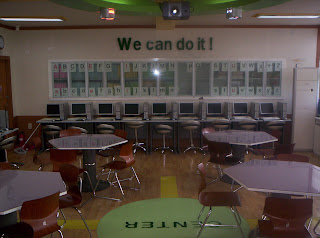 I'm still trying to figure this out. I can never have too many lesson plans but I can never follow through with one all the way through. Teaching a class of developing minds is like navigating the sea: you need a compass and a direction, an intention and a destination, but if the current ever shifts direction you can't ever fight it, you've just got to change course for a little while. Fortunately I can always catch a nice breather if I'm ever feeling a little taxed.
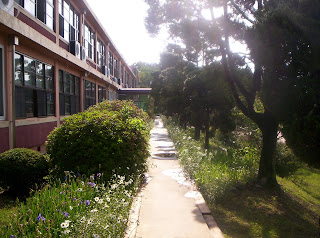 A front view of Jo-an elementary from the side. Right before lunch my kindergardeners invited me to a birthday party!
 . . . until we found a rabbit.
 We lost it somewhere in the bushes. After this I eat lunch and teach three afternoon classes. I find myself emulating my middle and high school Latin and math teachers to teach my sixth graders grammar.
 And no, I don't have a Korean girlfriend and I can't speak fluently.
 Friday morning I missed my bus so I grabbed a taxi. I pass a narrow bridge over a large river and then I'm at my school. Here's a mountain in the distance. That's my bank to the right.This is a garden at my school. It's very beautiful! Jo-an Elementary has a lot of property, and they don't let any of it go to waste. Our soccer field is huge, our playgrounds are frequent, and we have a driving range as well as a garden for each grade to practice their farming. We're actually a very small school with only one homeroom teacher for each grade level. We are also an associate school of another school in Guri. Like General Nash Elem, we get the problem kids. A common kinship has been established.This must be what I look like to my students. This picture was taken by CH.
 CH is an awesome student but he's a few levels above the other third grade boys. Being a sort of ringleader, can often be a deciding factor in how the class goes. However, there is never just ONE deciding factor. Teaching a class of 10 year-olds who don't understand most of my vocabulary demands a wide range of control.
For instance: how can I find a balance between ten girls--sensitive but eager to learn, and ten boys--full of energy but unwilling to sit down--without losing someone in between? The trouble is if I lose someone then they might bring someone else along with them, and then one by one the whole class is gone.
I find that a very active game will get the boys going but the girls crying (since they usually can't keep up with the physical energy of the boys). Yet a well planned arts & crafts project can entertain the girls but fail to grab the interest of any of the boys. What's the best way to utilize an English classroom?
I'm still trying to figure this out. I can never have too many lesson plans but I can never follow through with one all the way through. Teaching a class of developing minds is like navigating the sea: you need a compass and a direction, an intention and a destination, but if the current ever shifts direction you can't ever fight it, you've just got to change course for a little while. Fortunately I can always catch a nice breather if I'm ever feeling a little taxed.A front view of Jo-an elementary from the side. Right before lunch my kindergardeners invited me to a birthday party! I got dragged around the playground. . .
. . . until we found a rabbit.We lost it somewhere in the bushes. After this I eat lunch and teach three afternoon classes. I find myself emulating my middle and high school Latin and math teachers to teach my sixth graders grammar. It's funny how useless it is to try to apply anything I've learned in college.
Not only that, but I find that my English is reverting the more I speak to Koreans. Evolving, actually. The desire to get my point across is so strong that meaning takes priority over convention.
As I was talking to a girl this weekend I couldn't figure out where her accent was from. She said she was Canadian. She said that she's been traveling and speaking to people so much and with her personality and development as a theatre major that she can't help but pick up the variations of dialect from the people she meets.
I guess this is how dialects form. Pigdin, Ebonics, and my new recent favorite, Afrikaans. I wonder if there will ever develop a sort of dialect amongst foreigners in Korea. It would be like a global tongue with the incorporation of many "Koreanisms" (this is what I call the English tokens and phrases used by so many Koreans which I already notice many foreingers in Korea unconsciously using--such as the frequent use of the word "delicious," and the threefold "OK").
My friend Brad pointed out how the Korean sense of humor reflects their language as the English affinity for wit reflects our own. Because of the lesser variety of descriptive words, rhyming words and similar sounds are an extension of their humor. It seems juvenile, but in English these things are so common that it is more humorous to hear the more contextual or creative use of words and phrases. Perhaps it has to do as well with the western high regard for the individual. Our sarcasm is not appreciated here.
But anyway I enjoy living here as much as I like observing the place. But I'm less of a tourist stomping around snapping pics. I live in a village. I've got to befriend the community, not exoticize them. Though some of their ways are mysterious, I can have fun without violating taboos.
Here's one more provacative picture from my school:
And no, I don't have a Korean girlfriend and I can't speak fluently.
Subscribe to:
Posts (Atom)